Horseshoe Crabs
Fascinating, Important, and Under Threat!
Richard Rathe, Febuary 2026 (Medicine, Science)
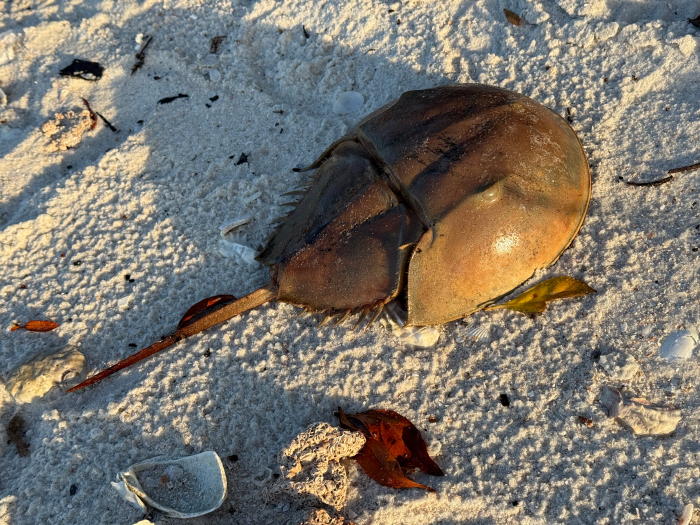
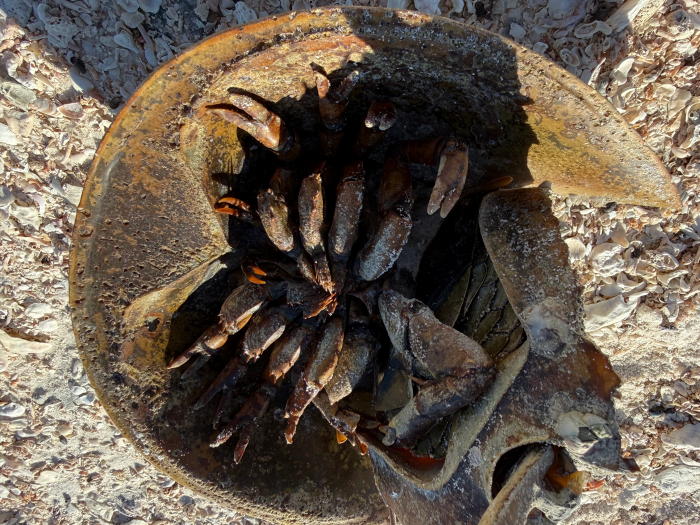
Horseshoe Crabs (Limulus polyphemus) evolved some 450 million years ago.[1] They have no close relatives in the world today. They are true living fossils and generally fascinating. First, they are not crabs—but remotely related to spiders. They have nine eyes, two underneath near the legs. They have twelve legs, including specializations for pushing, feeding, and mating (males). They breathe and excrete using book gills just behind their legs. And here's the best part—they chew with their knees!
Medical Use
They have a very early version of immune system that depends on something called Limulus amebocyte lysate
or LAL to detect bacterial toxins and clump
together to neutralize those bacteria/toxins.
This is scientifically very interesting in terms of evolution, etc.
Some bright scientist figured out that LAL could be used to detect contamination of vaccines and related medical stuff. Since that discovery HSCs have been commercially milked
(actually more like a blood donation) to produce LAL for the pharmaceutical industry. [Before that they killed thousands of rabbits for this purpose. This was an improvement, and necessary, but read on for why it is no longer acceptable!]
![Horseshoe crabs are bled at a facility in Charleston, S.C., 2014 [2]](img/horseshoe-crabs-being-milked.jpg)
Abstract:Horseshoe crabs have been integral to the safe production of vaccines and injectable medications for the past 40 years. The bleeding of live horseshoe crabs, a process that leaves thousands dead annually, is an ecologically unsustainable practice for all four species of horseshoe crab and the shorebirds that rely on their eggs as a primary food source during spring migration. Populations of both horseshoe crabs and shorebirds are in decline. This study confirms the efficacy of recombinant Factor C (rFC), a synthetic alternative that eliminates the need for animal products in endotoxin detection. Furthermore, our findings confirm that the biomedical industry can achieve a 90% reduction in the use of reagents derived from horseshoe crabs by using the synthetic alternative for the testing of water and other common materials used in the manufacturing process. This represents an extraordinary opportunity for the biomedical and pharmaceutical industries to significantly contribute to the conservation of horseshoe crabs and the birds that depend on them.[emphasis added]
From Saving the horseshoe crab: A synthetic alternative to horseshoe crab blood for endotoxin detection [3]
Bottom Line: There is an approved alternative to LAL called recombinant Factor C (rFC) out there, but Pharma mostly still relies on milking HSCs.
Now in 2026: A lawsuit is filed to protect ancient horseshoe crabs. [4]
This is basically an over-fishing story with a rather odd and spiny subject. Even if they aren't warm and fuzzy we need to stand up for these magnificent creatures, and the ecological webs that depend on them!
References
- [1] The Horseshoe Crab: Same as It Ever Was?, Jess Romeo November 16, 2020, https://daily.jstor.org/the-horseshoe-crab-same-as-it-ever-was/
- [2] Coastal biomedical labs are bleeding more horseshoe crabs with little accountability, https://www.npr.org/ 2023/06/10/1180761446/coastal-biomedical-labs-are-bleeding-more-horseshoe-crabs-with-little-accountabi
- [3] Saving the horseshoe crab: A synthetic alternative to horseshoe crab blood for endotoxin detection, https://doi.org/10.1371/journal.pbio.2006607
- [4] A lawsuit is filed to protect ancient horseshoe crabs, https://www.wusf.org/environment/2026-01-06/lawsuit-filed-protect-ancient-horseshoe-crabs
Related Links
The pharmaceutical industry must embrace synthetic alternatives to horseshoe-crab blood
Misc Photos
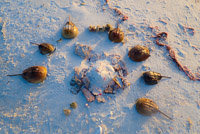
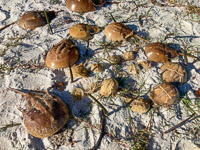
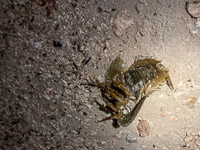
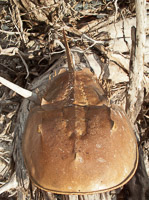
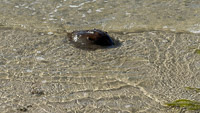
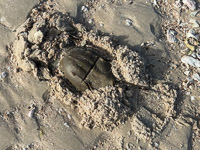
Photos 0003, 0005, 0034, 0071, & 0072 show living horseshoe crabs, 0005 was stranded under my hammock at high tide, I turned him right-side-up of course. 0072 shows a pair mating (I think). Photos 0001, 0002, & 0004 are sand art left using HSC husks.
(click any image to view or advance)