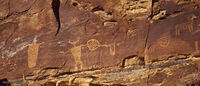
Road Trip West 11, Nine Mile Canyon
Richard Rathe April 2026 (Birds, Flowers, History, Rock_Art)
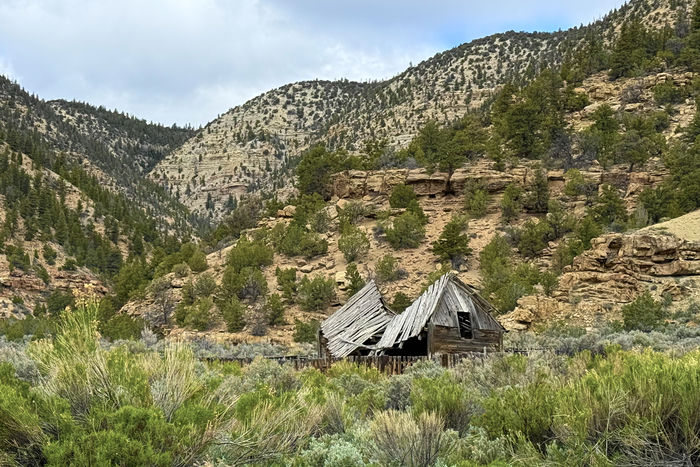
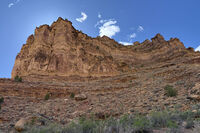
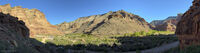
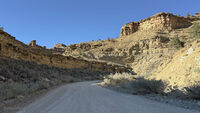
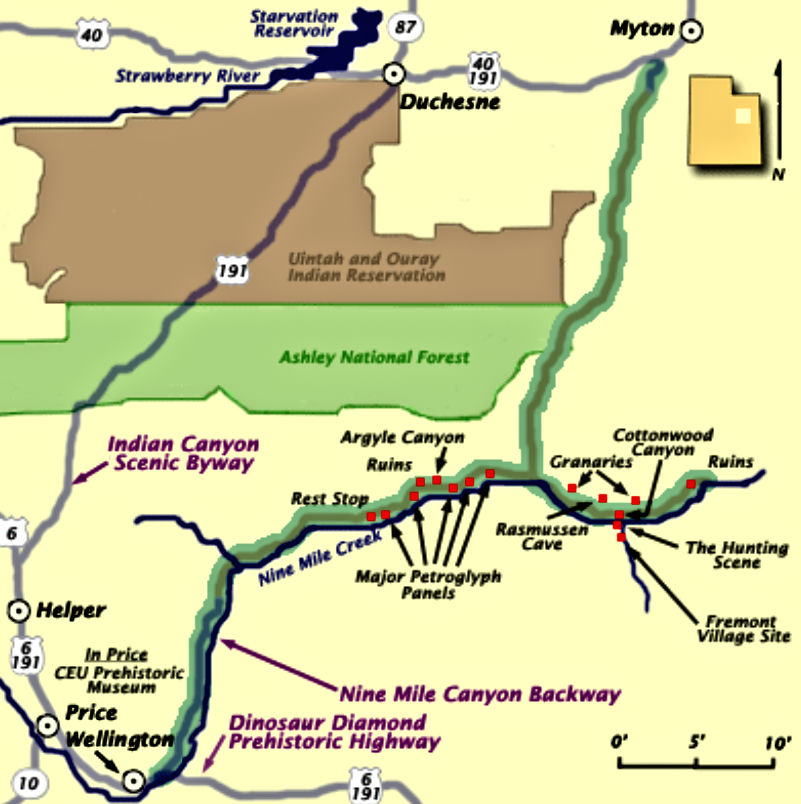
We left Green River heading north to Wellington and the Petroglyph megasite known as Nine Mile Canyon. The backway
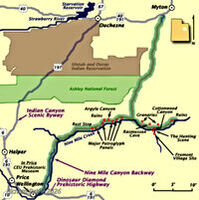
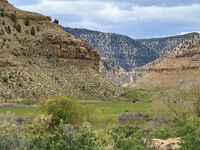
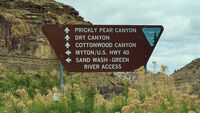
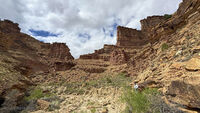
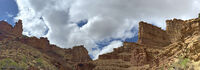
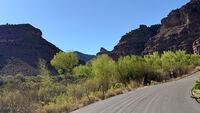
road went over a small pass before descending into a beautiful flat-bottomed canyon. This is the best map I could find on the web. [source: National Scenic Byways Program]
Vandalism
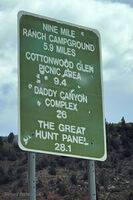
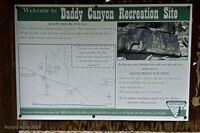
There were numerous signs detailing the recent uptick in vandalism in the area and a number to call to report new activity. This took on a sense of urgency when we started to see inscriptions that looked old, but were just wrong
—injecting a level of uncertainty when viewing the art. What's old, what's not?! 🙁
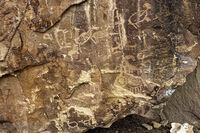
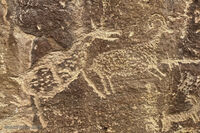
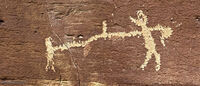
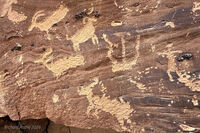
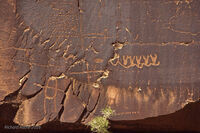
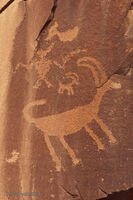
Here is the most obvious example we found. The bird on the left is clearly modern. And on closer inspection you'll see the other figures have modern touches or too much detail. Also, see how bright
they are? This fresh
appearance is a sign of more recent activity—but not always helpful.

There was evidence of very old red painted figures (pictographs) in a few places. The best of these was in a shallow cave which is apparently on private property (protected by a big log fence). I have to assume the property owner painted the no trespassing
sign over this important artifact. 😱

Coyote Placing the Stars
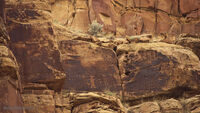
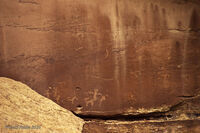
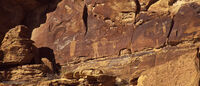
Many of the panels are high up on the cliff sides and nearly inaccessible. The BLM has provided sighting tubes to help direct your eyes to some of these.
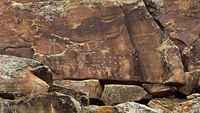
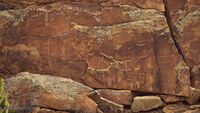
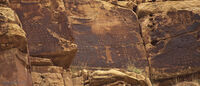
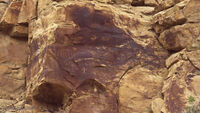
The most spectacular was Coyote Placing the Stars about 100 ft up from where we stood. This is the only North American rock art I'm aware of with a direct link to popular Native American folklore. There are several versions of this story. Signs at the site indicated the stars fell down and Coyote placed them back in the sky. This children's book version says he only re-arranged the stars, placing them into constellations representing his fellow animals. [See bibliography on the last page of the PDF for original sources.]

The scene spans several panels centered on the anthropomorphized Coyote figure. It has an almost ancient Egyptian feel to it! Grid-like fields of stars fan out on either side of the central figure. Exceptional!
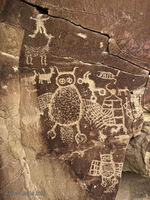
The Cross-Eyed Owl
The next major panel—referred to as The Cross-Eyed Owl—has a more recent origin and apparently served as a site for Ute Bear Cult
ceremonies.

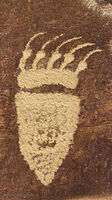
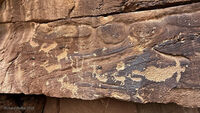
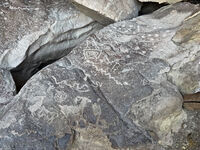
There's a lot going on here, including an obvious human hand, two owl figures, and bear footprint with claws. I'm fairly certain that several of the humanoid figures have been vandalized in their genital area. 🙁
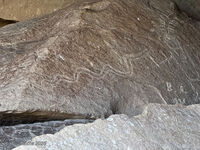
Here is the Bear Footprint close up…

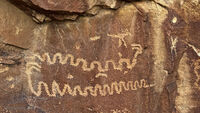
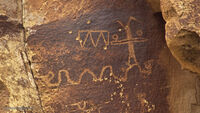
This nearby panel appears to show Two Snakes with Horns?!

Desert Plants
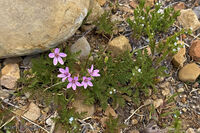
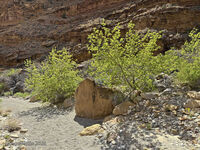
A few flowers were blooming and lots of deep orange lichen on the rocks.


More Petroglyphs
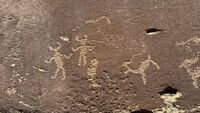
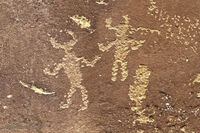
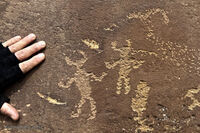
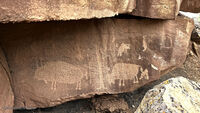
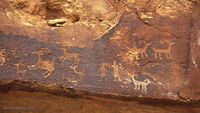
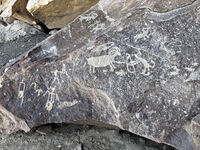
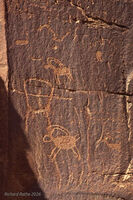
In this complex panel there are three human forms that appear to be carrying something and a very large big-horn sheep. For some reason the horned figure on the left reminded me of an octopus with a ring of keys.
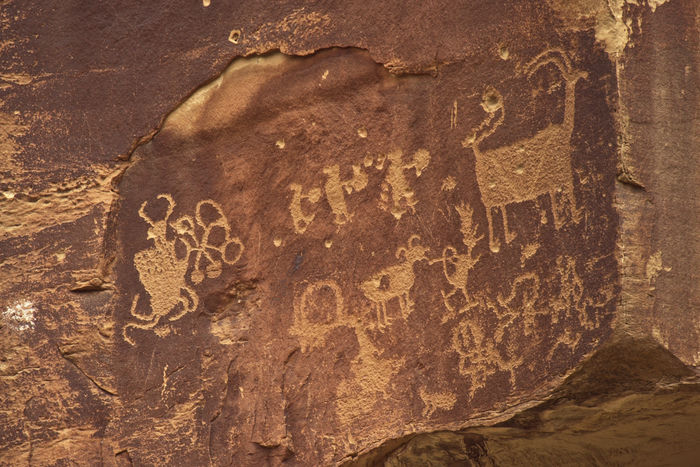
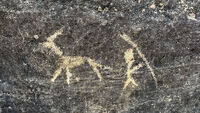
A minor panel behind a boulder had what appeared to be two horned figures dancing.

Granary & Canyon Hike
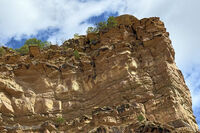
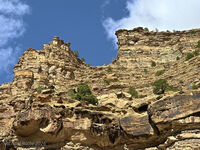
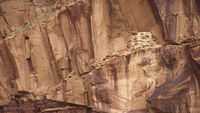
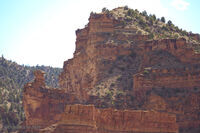
There are two of these ancient food storage granaries on the cliffs. Very difficult to find with the naked eye. Fortunately there was a sighting tube to help us. How the original owners actually got to their larder I have no idea?!

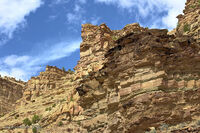
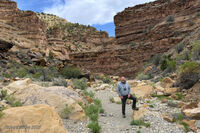
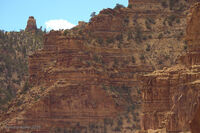
We took a break and went for a short hike up a side canyon with spectacular cliffs on both sides.


Still More Petroglyphs
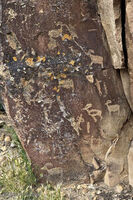
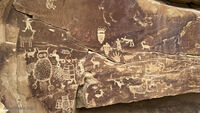
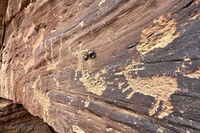
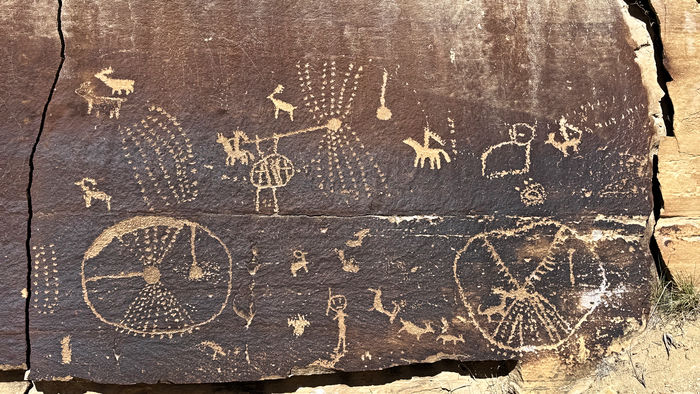
Here is another panel high up on the cliff face. There are several big horn sheep, a centipede, fields of stars, and a human figure.

This is a more recent Ute Style
panel. It may include some deep fake
vandalism (the two brighter elk images upper left & man on horse just to the right of center).
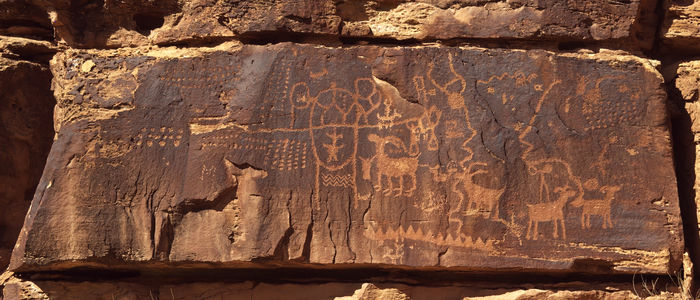
There was a iconic Oval Man
figure I'd never seen before repeated in several places.

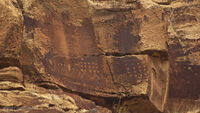
The most elaborate version was on this magnificent panel. There are sheep, stars, what I think are water/rain symbols, and two human figures that appear to be holding something above their heads. Wow!
You could easily miss this one—a man with a winged headdress. Note how brown the pecked areas are. This means the desert varnish has had enough time (hundreds of years) to reestablish itself.

The Cave
Finally there is the Rasmussen Cave
. This shallow indentation has at least two large red Pictographs of Elk (vandalized, see above) and several small groups of Petroglyphs. Some of the later may also be recent vandalism.

Note the bow string in the photo above. It looks like a later addition to me.
Here is a panorama of the entire valley, viewed from the fence in front of the cave.

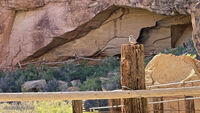
While getting ready to leave I noticed this bird flitting around hawking for insects. It turned out to be a new species for me: Say's Phoebe. 🙂 The cave and a bit of the vandalism are visible in the background.

We exited to the north and soon discovered that road was gravel, very bumpy, and slow going in my little car. Our average speed was less than 20mph most of the way. Once over the pass the road became paved. We descended on a long downhill into a wide valley with a few ranches and many oil wells.

Photo Gallery
(click any image to view or advance)